The ultimatum delivered by my parents was as absurd as it was callous: sell the catering company I had spent twelve years building from the ground up, and hand over the proceeds to cover my sister Madison’s nearly $1 million debt. When I refused, they took matters into their own hands, breaking into my commercial kitchen under the cover of night to vandalize and destroy everything I owned. They were convinced that by stripping away my leverage, they had forced my absolute surrender. What they utterly failed to realize was that I had already taken a quiet, decisive step that would instantly transform their malicious victory into an absolute disaster for them.
Part 1: The Ultimatum
The first time my mother suggested I liquidate Bennett & Bloom Catering, she tossed the demand into the air as casually as if she were asking me to pass the salt shaker across the dining table. Three days later, she would stand inside my thoroughly vandalized production facility alongside my father and sister, utterly convinced that turning my life’s work into a heap of twisted metal and shattered glass would leave me with no alternative but to obey.
My name is Claire Bennett, and Bennett & Bloom was never merely a business to me. It represented twelve grueling years of borrowed ovens, sleepless weekends, three battered delivery vans, forty-two dedicated employees, and thousands of meticulous decisions that slowly transformed a damp church-basement operation into one of the most sought-after catering enterprises in the city.
By thirty-four, my calendar was booked eighteen months in advance with high-end museum galas, massive corporate product launches, and exclusive weddings. I knew the distinct mechanical hum of every refrigerator, every scratch on our stainless-steel prep counters, and the birthday of nearly every staff member because I had built the company one exhausting, sweat-soaked event at a time.
My younger sister, Madison, had spent those exact same years treating money as though it existed solely to subsidize her vanity. Endless luxury leases, designer wardrobes, failed online startups, and increasingly reckless investments piled up one after another until her latest luxury beauty venture collapsed under nearly a million dollars in private debt.
That catastrophic financial implosion prompted my parents to summon me to what they pompously declared an emergency family dinner. My father waited until everyone was seated before sliding a thick manila folder across the mahogany table toward me.
“Your business is worth enough.”
I stared at him, genuinely unsure whether my ears were playing tricks on me.
“Enough for what?”
My mother answered before he could even draw another breath.
“To sell. Madison needs nine hundred and eighty thousand dollars by the end of the month.”
Madison didn’t even have the grace to look remotely embarrassed. She casually lifted her wine glass, gazing at me as if the solution to her utter ruin should have been blindingly obvious.
“You can just start another company.”
I let out a short, cynical laugh, honestly believing they were testing a sick joke. But my father’s rigid, unblinking expression instantly told me they were entirely serious. In their insular worldview, twelve years of my relentless, round-the-clock labor had magically become an emergency relief fund for Madison’s latest financial dumpster fire.
“Family comes before pride,” my father declared, his voice dropping into a tone of absolute moral authority.
“This isn’t pride,” I replied, my anger beginning to flare. “It’s payroll. It’s legally binding contracts. It’s forty-two people’s livelihoods.”
Mom leaned forward, adopting the exact pious facial expression she had weaponized throughout my childhood whenever she wanted to disguise pure cruelty as a noble sacrifice.
“Your sister could lose everything she owns.”
“She already lost everything,” I said coldly. “Now she wants to take mine.”
The silence that settled over the dining room turned sharp and brittle. Instead of pausing to reconsider the sheer audacity of their demand, my father hardened his jaw and delivered the ultimatum they had clearly rehearsed before I even walked through the door.
Sell Bennett & Bloom, transfer the proceeds directly to Madison’s private creditors, or consider myself permanently excommunicated from the family.
I stood up from my chair, reached for my winter coat, and looked each of them in the eye before giving the only answer my conscience would allow.
 “Then stop considering me family.”
What none of them knew was that two months earlier, following a suspicious late-night attempt to break into one of my delivery vans, my attorney Lena Ortiz had strongly advised me to comprehensively restructure the corporate armor. The building leases, heavy equipment, proprietary recipes, commercial trademarks, and client contracts were no longer personally vulnerable; they were safely shielded inside a hardened operating company backed by comprehensive commercial insurance, biometric access logs, and twelve high-definition security cameras streaming encrypted footage directly to an off-site cloud server.
There was another crucial detail my family remained entirely ignorant of. I had already signed a conditional acquisition agreement with Sterling Hospitality Group. The contract explicitly stipulated that if Bennett & Bloom ever suffered a qualifying criminal disruption, Sterling was legally bound to accelerate the buyout and fund an immediate facility relocation rather than walking away from the table.
Two days after our disastrous family dinner, my phone buzzed with another voicemail from my mother, her voice dripping with ice.
“You’ll regret choosing a kitchen over your own blood.”
I didn’t bother arguing. There was nothing left to debate. I simply saved the audio file to my secure archives and went back to managing my kitchen.
At precisely 2:17 on a damp Thursday morning, my security provider’s automated call pulled me violently from a deep sleep. The operator informed me that a forced entry was actively occurring at our main production facility and confirmed that local law enforcement had already been dispatched.
“Ms. Bennett, we are registering a forced entry at the production facility.” “Police?” “Dispatched.”
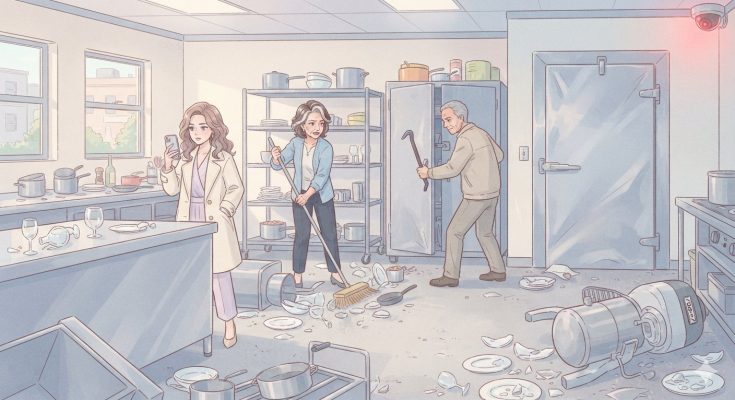
Seconds later, motion alerts began flooding my phone screen, prompting me to open the live security feed. What I witnessed made every drop of blood in my body run cold, because my father was aggressively driving a heavy crowbar into my dry-storage cabinetry, while my mother gleefully swept expensive glass jars and porcelain serving platters off the shelves onto the concrete floor.
Madison stood near my primary prep station wrapped in an expensive cream coat, casually recording the vandalism on her smartphone while my father overturned an industrial mixer worth more than her first car. Then Mom pointed a gloved finger toward the massive walk-in refrigerator and barked another destructive command.
“Do that one too.”
My father immediately began ripping out the delicate refrigeration control panel while Madison laughed out loud. They weren’t just attempting to intimidate me; they were systematically demolishing the very asset they had commanded me to liquidate.
For a terrifying second, my instinct screamed at me to jump in my car, drive down there, and tear into them myself. Instead, I forced my breathing to steady, stayed put in my apartment, and dialed Lena Ortiz. My family genuinely believed they were erasing my leverage and backing me into a corner. What they completely failed to grasp was that every high-definition camera was documenting their felonies, every file was safely mirrored off-site, and their malicious rampage had just tripped security triggers they didn’t even know existed.
Part 2: They Thought They Had Won
Local police arrived at Bennett & Bloom precisely nine minutes after the alarm tripped, but my parents and Madison had already slipped away through the rear loading bay. When I pulled up to the facility just before dawn, the production floor looked as though a violent natural disaster had torn straight through it. Shattered porcelain platters littered the floor, raw ingredients coated the prep tables, broken plumbing fixtures leaked water across the tiles, ruined refrigeration controls blinked erratically, and nearly two hundred thousand dollars in specialized culinary equipment lay in utter ruins.
Taped squarely to my office door was a handwritten note that eliminated any lingering ambiguity about their true intentions.
“NOW YOU HAVE NOTHING TO SELL.”
The responding detective photographed the paper twice before sliding it carefully into an evidence bag. I stood motionless in the wreckage, surveying twelve years of relentless, backbreaking work scattered in the dirt. Yet, beneath the surging wave of fury, a much colder, sharper clarity took hold. My family genuinely believed they had permanently solved all of Madison’s financial problems by obliterating mine.
By sunrise, my mother’s name lit up my phone screen.
“You should have just listened to us,” she said, her voice dripping with self-righteous irritation. “You broke into my business and destroyed it.” “Don’t be so dramatic, Claire. Your father and I helped fund your startup twelve years ago.” “You loaned me four thousand dollars, which I paid back with interest a decade ago.”
Before my mother could reply, Madison snatched the phone, her tone still projecting the infuriated entitlement of someone who genuinely believed she was the victim.
“Insurance will cover most of the physical damage anyway. Just sell whatever is left of the scrap and help me settle this debt.”
That single sentence crystallized the terrifying truth of how completely delusional they were. They honestly believed they had reduced Bennett & Bloom to a pile of broken metal and an insurance payout, entirely blind to the fact that the company’s legal structure had been airtight long before they ever set foot inside my building.
“You three need to retain criminal defense attorneys immediately,” I said flatly.
My father instantly lunged for the phone, his voice booming with panic and outrage. “Are you seriously threatening us?” “No, Dad. I’m being professionally courteous.”
I ended the call, walked back inside the ruined facility, and joined Lena and the lead detective as they reviewed the security server footage. Every single camera had captured the destruction in pristine clarity: my father forcing the rear door open with a crowbar, my mother directing him toward high-value equipment, and Madison cheerfully recording video while laughing beside the smashed prep tables.
Around noon, Sterling Hospitality’s regional president arrived in a black sedan, walking silently through the devastated kitchen. After reviewing my comprehensive incident report on a secure tablet, he looked up, met my eyes, and confirmed the exact clause I had been praying for all morning.
 “This incident officially triggers Section Fourteen of our acquisition agreement.”
I nodded slowly. Section Fourteen was the precise legal safety net my attorney and I had integrated into the buyout terms months prior. Because Sterling’s acquisition of Bennett & Bloom was already deep into the final due diligence phase, a covered criminal disruption did not cancel the deal—it automatically accelerated it.
Sterling was legally mandated to purchase the company at the exact multi-million-dollar valuation we had previously negotiated, immediately finance a fully outfitted temporary production facility, and reserve the full legal right to aggressively recover all financial losses and damages from the criminal perpetrators responsible. My parents had tried to render my business worthless, but in doing so, they had triggered the exact contractual mechanism that preserved its immense value and forced the buyout forward at lightning speed.
Then Lena motioned me over to one of the secondary camera monitors, rewinding the footage to show Madison standing directly in front of the walk-in refrigerator, speaking right into the lens.
 “Once Claire gets the insurance check, Mom is going to force her to hand it all over anyway.”
The detective listened to the audio twice before raising a knowing eyebrow. “Well, that certainly removes any doubt about criminal conspiracy and premeditated motive.”
For a long moment, absolute silence hung in the room. I stared at the frozen image of my sister smiling amidst the wreckage she had engineered, finally accepting a painful reality: for my entire life, protecting my family from the natural consequences of their own actions had merely taught them how to exploit me.
“Good,” I said softly, my voice devoid of hesitation. “Because I am entirely done protecting them.”
Part 3: The Meeting That Changed Everything
Six days after the break-in, my parents and Madison walked into the sleek conference room at Lena’s downtown law firm radiating the exact same arrogant confidence they had relied on for decades to bully me into submission. My father aggressively slammed a printed legal notice onto the polished conference table, my mother settled into her chair with her arms tightly crossed, and Madison wore oversized designer sunglasses indoors—treating the meeting like an inconvenient scheduling hiccup rather than a catastrophic legal crisis.
Dad barely waited for the rest of us to take our seats before barking his primary demand. “Call off the police complaint right now.”
I looked calmly across the massive table at him. To my right sat Lena; to my left sat a senior corporate attorney representing Sterling Hospitality. “No.”
Mom’s expression instantly turned hard and venomous. “We are your flesh and blood. We are your parents.” “You were also the three individuals captured on multiple high-definition cameras systematically vandalizing my commercial property.”
Madison gave a sharp, dismissive scoff and leaned back lazily in her executive chair. “Oh, please. It’s just an internal family dispute over a silly business.”
Before I could open my mouth, the Sterling corporate attorney calmly opened a thick leather binder and shut down her delusion with chilling precision.
 “No, Ms. Bennett. This is a severe commercial felony directly affecting federally insured assets, forty-two active employee payrolls, commercial supply contracts, and a multi-million-dollar corporate acquisition.”
For the very first time since they strode into the room, Madison’s defensive bravado visibly cracked. Lena smoothly slid three glossy 8×10 photographs across the table: the first showed my father violently prying open the rear entrance; the second showed my mother gleefully smashing commercial inventory; the third showed Madison pointing toward the refrigeration unit while destruction raged around her.
Next to the photographs, Lena placed a precise, verbatim transcript of the security audio feed. The color drained entirely from my father’s face as his eyes scanned the printed words of his own criminal instructions—words they never dreamed would be recorded or heard by outsiders.
Mom stared at me in horror, her voice trembling slightly. “You… you actually recorded us?” “My commercial security infrastructure did.”
In a calm, methodical tone, Lena outlined the cascading legal reality. The commercial insurance carrier had formally accepted the property damage claim subject to active criminal prosecution. Sterling Hospitality had officially invoked Section Fourteen, accelerating the acquisition, funding a brand-new temporary production hub, and stepping in to protect all contracted client events. Furthermore, both the insurer and Sterling were aggressively preserving their independent legal rights to sue my parents and Madison personally for full restitution, lost commercial revenue, and punitive damages.
State prosecutors were already reviewing the video files, forensic audio transcripts, and physical evidence pulled from the facility. What my family had foolishly imagined to be a private act of domestic intimidation had instantly mutated into a massive, documented commercial crime involving corporate plaintiffs, insurance investigators, state prosecutors, and top-tier legal teams.
Madison ripped off her sunglasses, her voice rising in sheer panic. “You’re actually going to let these corporate lawyers come after us over some broken kitchen equipment? We’re your family!” “You didn’t just attack equipment,” I replied, my voice hard as steel. “You actively targeted forty-two innocent people’s livelihoods simply because I refused to surrender what I built with my own hands.”
Dad lost all control, slamming his open palm against the heavy conference table so hard the water pitchers rattled. “We made you who you are!”
It was a phrase I had heard echoing through my childhood whenever my parents wanted manufactured gratitude to erase my personal boundaries. But hearing it now, in this sterile corporate room, it sounded pathetic and hollow.
“No, Dad,” I said quietly. “You didn’t make me. You simply taught me the exact kind of person I never, ever wanted to become.”
Nobody in the room dared to speak.
Then Lena delivered the final financial reckoning. Between structural architectural repairs, specialized import culinary equipment, spoiled organic inventory, emergency vendor fees, lost commercial revenue, and mandatory security upgrades, the initial combined civil and criminal liability claim had already skyrocketed past six hundred thousand dollars. Combined with the nearly one million dollars Madison still owed her ruthless private lender—who had just caught wind of her active criminal investigation—her fragile financial house of cards collapsed entirely.
The emergency extensions Madison had spent months begging her lenders for vanished overnight. The massive debt that had ignited this entire nightmare was still hanging over her head, but now my family had successfully added hundreds of thousands of dollars in inescapable restitution, legal fees, and civil judgments to their burdens.
Madison stared blankly across the table, her voice dropping to a panicked whisper. “You… you knew all of this would happen if we went in there, didn’t you?”
I looked at my younger sister for a long, unblinking moment before giving her the unvarnished truth. “No, Madison. I simply knew how to protect my company. You were the ones who decided what happened next.”
That was the fundamental pill none of them could swallow. I hadn’t meticulously trapped them in a web; I had simply refused to leave myself defenseless against their greed.
Part 4: The Consequences They Never Expected
The wheels of justice moved with a terrifying speed that my family never anticipated. Within weeks, local prosecutors officially slapped both my mother and father with felony charges for third-degree burglary, criminal mischief, and conspiracy to commit property destruction. Madison was hit with identical conspiracy and property-damage charges; her smug insistence that she was merely a passive bystander evaporated the moment prosecutors played the crystal-clear security audio of her narrating the vandalism and plotting the insurance fraud.
Faced with overwhelming, incontrovertible digital evidence, their defense attorneys frantically negotiated plea agreements to avoid maximum prison sentences. Mom received a stern sentence of intensive probation coupled with mandatory community service and joint financial restitution. Madison received probation and severe financial penalties that cemented her total insolvency. My father, however, as the physical perpetrator who forced entry and spearheaded the physical destruction, received a short custodial sentence in the county correctional facility—a stark, humiliating reality check for a man who had spent his entire life hiding behind his suburban country club status.
Yet, the criminal convictions were only the opening salvo of their nightmares. Sterling Hospitality’s corporate legal team and the commercial insurance underwriters relentlessly pursued full financial recovery. Every dollar spent on specialized equipment replacement, emergency sanitation, ruined inventory, round-the-clock security guards, and disrupted corporate catering contracts was systematically itemized and slapped with civil lawsuits.
To scrape together funds for their mounting legal fees and court-ordered restitution, my parents were ultimately forced to put their suburban home on the market, downsizing into a cramped, dismal apartment across town. Madison, already drowning in nearly a million dollars of toxic private debt, lost every remaining asset she possessed and officially filed for personal Chapter 7 bankruptcy under the crushing weight of her legal judgments.
Did I feel a rush of euphoric triumph watching their empire crumble?
Surprisingly, no. There were moments when well-meaning friends assumed I must feel deeply vindicated watching the people who tried to ruin me face the full weight of the law. But true vindication wasn’t what lingered in my chest. Mostly, I felt an overwhelming, profound exhaustion at how entirely needless the whole tragedy had been.
Madison could have simply accepted adult accountability for her failed luxury startup. My parents could have sat her down and gently explained that genuine parental love does not mean sacrificing another child’s livelihood to bail out a sibling’s reckless financial gambling.
Instead, they operated under the toxic entitlement that my hard work belonged to the collective family pool whenever Madison painted herself into a corner. For years, I had quietly played the role of the reliable daughter—the one who worked seventy-hour weeks, solved crises, remembered every family birthday, and silently absorbed whatever chaotic tension Madison generated. Somewhere along the way, my parents had catastrophically confused my fierce independence with infinite capacity, treating my success as a public utility they could tap whenever my sister ran out of options.
The hardest psychological hurdle was realizing that even after the handcuffs clicked shut and the court gavels slammed, my family still desperately clung to their narrative of victimhood. Mom left me a final, weeping voicemail insisting that everything had “simply gotten entirely out of control,” while my father had his defense attorney fire off a bitter letter accusing me of heartlessly inviting cold corporate strangers to punish my own flesh and blood.
I never dignified either message with a response.
There was nothing left to explain because I had already laid out the core truth in that lawyer’s conference room: forty-two hardworking employees depended on Bennett & Bloom to feed their families, and my parents had chosen to jeopardize all of them simply because I refused to hand over my life’s work on a silver platter.
Meanwhile, Sterling Hospitality moved with incredible efficiency to ensure my business didn’t miss a single beat. They immediately financed a fully equipped temporary production space in a secure commercial district, funded the rapid transfer of our core operational systems, helped us honor our massive backlog of booked events, and issued reassuring press releases confirming that Bennett & Bloom’s high-end culinary standards would continue without a single day of interruption.
On our first morning operating out of the temporary kitchen, my entire staff showed up before the sun crested the horizon. Several of my veteran prep chefs and logistics managers had worked side-by-side with me for nearly a decade. Not a single one of them asked awkward questions about Madison’s debts or my parents’ criminal trials.
They simply walked up to the stainless-steel prep tables, tied their aprons, and asked the only question that mattered: “Boss, what needs to get prepped first today?”
Standing there in the warm glow of the morning ovens, watching commercial trays slide into convection racks and delivery vans rumble out onto the asphalt on schedule, I finally understood what true loyalty looked like. Real family wasn’t about demanding that you self-destruct to rescue someone else from their own manufactured fires.
True family—and true community—was standing shoulder-to-shoulder while you rebuilt from the ashes.
Part 5: What Survived Them
Eight months after that terrifying night of destruction, Bennett & Bloom officially transitioned into our permanent home: a sprawling, ultra-modern culinary production and event facility constructed with direct backing from Sterling Hospitality’s regional division. The multi-million-dollar acquisition had closed smoothly at the exact premium valuation we negotiated before the attack. Every single employee who wanted to stay retained their position with enhanced benefits, and I stepped smoothly into an executive role as regional culinary director while maintaining lucrative equity in the thriving brand I had spent twelve years carving out of nothing.
On our first Saturday operating in the new flagship headquarters, I arrived well before dawn to savor the familiar, comforting symphony of the morning prep rush. By sunrise, twelve distinct catering orders were moving simultaneously through our assembly lines, logistics teams were loading temperature-controlled vans, and the vibrant, organized chaos of a world-class culinary operation was humming smoothly—entirely free from the toxic interference of anyone sharing my DNA.
There was only one physical artifact from the old, vandalized kitchen that I chose to salvage and preserve. It was the heavily scorched, smoke-stained brass Bennett & Bloom logo plaque that had somehow survived the wrecking crew’s rampage. I mounted it proudly on the pristine wall of my new executive office—deliberately choosing it over framing the threatening note my parents had left behind or the grim photographs of their vandalism.
I didn’t need petty visual reminders of their cruelty. That scorched brass emblem told its own story. It stood as an unyielding testament to something far more powerful than what happened on a dark night in February.
My parents and sister had desperately tried to reduce twelve years of relentless grit and passion to a pile of twisted metal and broken drywall. But they fundamentally misunderstood the nature of what I had built. Bennett & Bloom had never merely existed inside the four physical walls of one building. It lived in our proprietary recipes, the unyielding loyalty of our veteran staff, the deep trust of our corporate clients, and the ironclad reputation we had earned one flawless plate at a time.
My parents eventually stopped trying to reach out through third parties. Their court-mandated restitution payments were automatically deducted from their dwindling assets, and Madison’s prolonged bankruptcy dissolved whatever lingering illusions she had about using the legal system to bail out her lifestyle.
I stopped tracking their movements.
Oddly enough, that apathy surprised me more than anything else. For months following the break-in, I had naively imagined that sweet, cinematic justice would feel like an intoxicating wave of satisfaction—that every legal penalty handed down would somehow magically balance the scales of what they had stolen from my peace of mind. Instead, I discovered a much deeper truth: the more my own professional and personal life flourished, the completely less interested I became in watching theirs implode.
One afternoon during a lull in service, Lena dropped by the new facility to review some final acquisition paperwork. She stood quietly near my office door, her eyes lingering on the scorched brass logo plaque before she offered a warm, knowing smile.
“You know, when we stood in that ruined kitchen eight months ago, your family genuinely believed they were erasing you completely.” “I know they did,” I replied softly, pouring two cups of fresh coffee. “And instead, they accidentally fast-tracked a multi-million-dollar corporate buyout and national expansion.”
I let out a genuine, unburdened laugh. “When you say it out loud like that, the entire sequence still feels completely surreal.”
Yet every word of it was absolute fact. My family had tried to obliterate the asset they wanted me to liquidate, only to unwittingly trigger the exact insurance protections and acquisition clauses that allowed Bennett & Bloom to relocate, scale up, and emerge infinitely stronger than it had ever been before.
Yet, the most profound transformation had nothing to do with corporate valuations or bank accounts.
For years, I had operated under the heavy emotional delusion that being a “good daughter” meant remaining perpetually on-call, endlessly forgiving, and infinitely sacrificial—no matter how unhinged or predatory the demands became. My parents had weaponized that exact belief system, and Madison had deliberately engineered her entire adult relationship with me around the comfortable assumption that my rock-solid stability existed primarily to cushion her endless freefalls.
That toxic illusion died the night they smashed my kitchen doors open.
I didn’t stop loving my family simply because cold, hard consequences finally caught up with them. I simply stopped buying into the lie that authentic love requires you to hand over your dignity, your safety, and your life’s work just because the people who raised you decided they were entitled to consume it.
Late one evening, long after the last delivery van had returned and the entire facility fell into a deep, peaceful hush, I walked slowly through the gleaming production kitchen. The commercial stainless-steel prep tables were brand-new, the ultra-efficient refrigeration units hummed with an unfamiliar, quiet power, and there wasn’t a single scratch, scar, or memory of betrayal defacing the pristine white walls.
For the very first time in my life, that empty slate didn’t make me feel hollow or anxious.
I had spent years laboring under the false belief that true survival meant obsessively rebuilding every single brick of what had been maliciously torn down. Now, standing in the heart of my new empire, I finally understood that true survival often means giving yourself permission to construct something vastly superior—without ever asking for permission, validation, or blessing from the people who tried to burn your world to the ground in the first place.
True revenge would have meant obsessively tracking every agonizing detail of my parents’ downfall and my sister’s financial ruin.
True freedom was realizing that I no longer needed to watch them fall at all.
